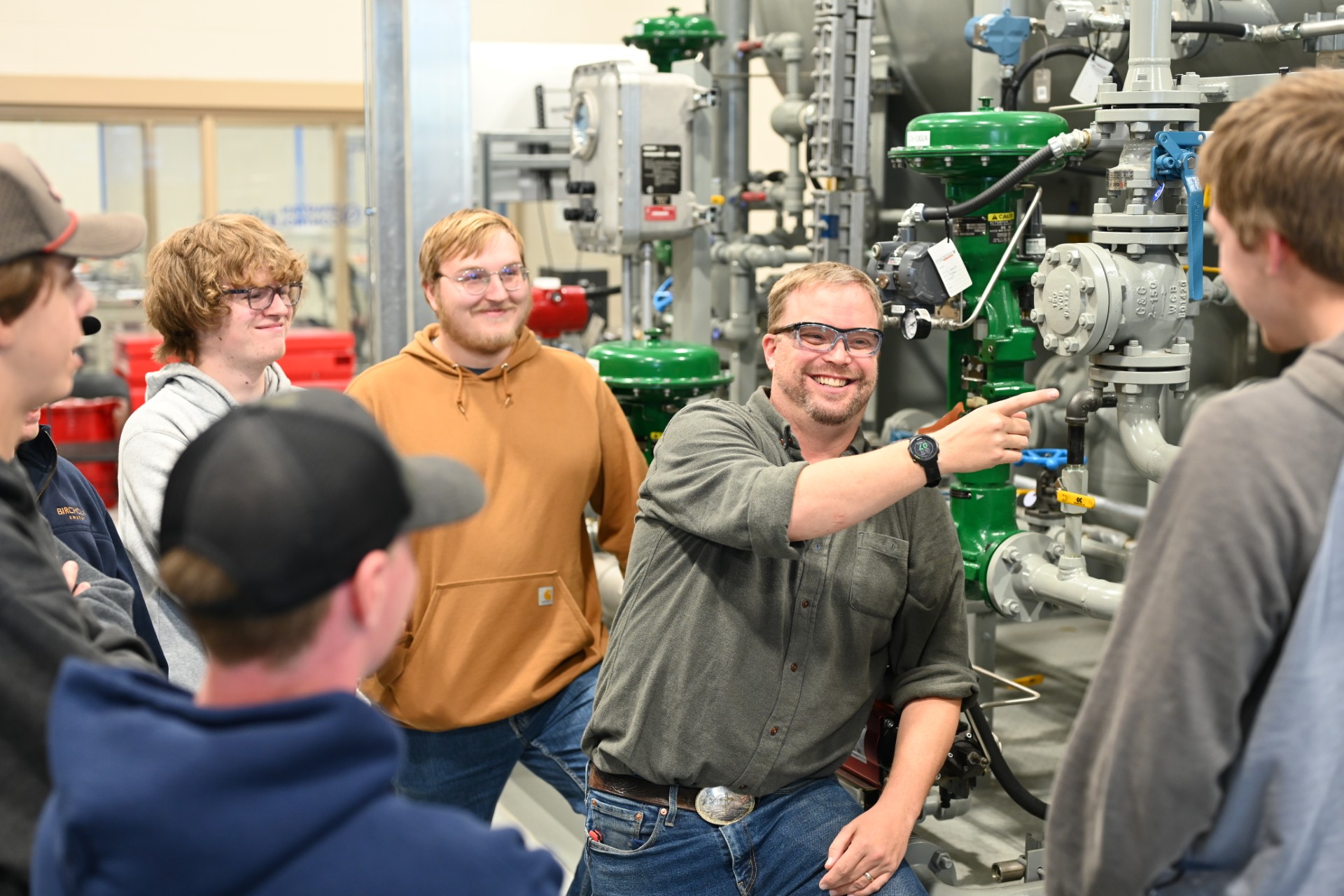
Unlike many young Canadians from rural communities, Nathan Parlee didn't have to go far from home to find opportunity after finishing high school.
Growing up in a small town near Grande Prairie, Parlee joined Alberta's Registered Apprenticeship Program when he was 17, earning credits in the classroom and hours on the job as an electrical apprentice.
By the time many of his classmates were just starting to figure out what to do after graduation, he was already building a career as an electrician, and later as an instrumentation technician in the oil and gas and commercial building sectors.
“There was opportunity right at my front door," Parlee said.
"It was a great time to be starting a career because I got in at the beginning of the liquid-rich natural gas development in the Montney and Duvernay."
More than two decades later, Parlee still lives in the same region where his career began.
The local boy whose family homesteaded in northern Alberta a century ago now teaches instrumentation and control technician apprentices at Northwestern Polytechnic (NWP) in Grande Prairie, helping prepare the next generation of tradespeople for careers in one of Canada's fastest-growing industrial regions.
With rising demand for skilled workers, the region is investing in opportunities for the next generation, including a new $29-million skilled trades training centre at NWP and a new power engineering lab supported by Cenovus Energy.
"I've been absolutely blessed with the opportunities that have been here in northwestern Alberta," Parlee said.
"I haven't had to leave and go far away. Now I live 25 or 30 kilometres away from where I grew up. That's a pretty cool advantage."
Growing demand for skilled workers
His story mirrors a broader transformation taking place across the Peace Region, where growing natural gas production, expanding LNG export markets, new power generation projects and emerging industrial developments are creating increasing demand for skilled workers.
This demand is arriving at a time when Canada is already facing significant labour shortages.
A recent report by GE Vernova projects up to 116,000 job openings across Canada’s energy sector by 2035, including major shortages in skilled trades such as millwrights, pipefitters and machinists, along with specialized technical and engineering occupations.
The combination of retirements, growing energy demand and new infrastructure development is expected to create sustained workforce pressures across the sector.
In northwestern Alberta, those trends are already visible.
The area's strategic location is increasingly linking its economy to LNG export facilities on British Columbia's coast, creating new demand for producers, processors, pipeline operators and the skilled tradespeople who build and maintain that infrastructure.
At the same time, growing interest in power generation and data centre development is creating unprecedented opportunities.
For employers, those opportunities also bring challenges.
"We are facing a manpower crunch. We're bringing more and more people in to gain experience, but many of the experienced people we need to train and mentor them are retiring,” Parlee said.
"While we’re dealing with rapid technological change, we're also dealing with a complete changing of the age demographic as well as expanded demand.”
Investing in the next generation
The resulting labour pressures are helping drive significant investment in local training capacity.
In August, NWP officially opened its new 40,000-square-foot Skilled Trades Training Centre, a $29-million investment designed to expand workforce training opportunities and support growing regional demand.
The new facility increases regional skilled trades training capacity to more than 1,500 seats and supports apprenticeship and trades training across 11 career pathways.
"Our enrolment numbers are already confirming what we had heard from local community members, industry leaders, and prospective students about the urgent need for this training in Grande Prairie," said NWP’s president and CEO Dr. Vanessa Sheane.
Few people have witnessed this growth more directly than Parlee.
When he joined the institution seven years ago, the instrumentation program offered only a single first-year intake annually. Today, NWP delivers multiple intakes across all four years of training.
"This year we're doing seven intakes," he said.
"Originally all we did was first-year instrumentation and now we're doing first, second, third and we're kicking off our first-ever fourth-year program. It's been an absolutely amazing journey."
Industry is helping support the expansion.
In October, NWP opened a new lab for its power engineering program, made possible with a $250,000 investment from Cenovus Energy.
The facility will provide students with hands-on experience using equipment and systems common in industrial operations.
Preparing for future growth
Beyond energy production itself, regional leaders are also preparing for future industrial growth.
In August, the provincial government named the Greenview Industrial Gateway a Designated Industrial Zone, a move intended to help attract major industrial and technology investment to the region.
It is Alberta’s second such zone, after the Industrial Heartland Zone was designated northeast of Edmonton in 2022.
Located on 75 square kilometres in the Municipal District of Greenview south of Grande Prairie, the industrial zone is designed to make the most of the region’s existing strengths including vast natural gas supplies, transportation connections, a cool climate with abundant water, and a growing workforce.
Opportunity close to home
For Parlee, the region's future ultimately comes back to its people.
His grandfather was a carpenter. His father was a heavy-duty mechanic. His uncle earned a Red Seal as a welder.
"My family came from an agricultural background but we’ve always had the skilled trades we could rely on to support our farming habit," he joked.
After building a career and returning to the classroom to help train future tradespeople, Parlee is encouraging young people to recognize the opportunities emerging in their own backyard.
"I do not regret my choice to become involved in the skilled trades," he said. "It has fed my kids and supported my family. I think I’ve done pretty well for a country kid."
The unaltered reproduction of this content is free of charge with attribution to the Alberta Energy Centre.


